Third-Party Inspection Process for Plug Valves
29 May, 2026
In order to help you understand the complete process of the third-party inspection of the plug valve, the following is a specific description of the steps we coordinate and conduct on-site witnessing inspections with BV, DNV or SGS. We have four stages of the whole process.
Stage 1: Pre-Inspection Preparation
What we complete
What we need from you or the inspection body
Stage 2: On-Site Arrival & Document Review
On the first day of inspection
Potential issues to note
Stage 3: On-Site Witness Testing
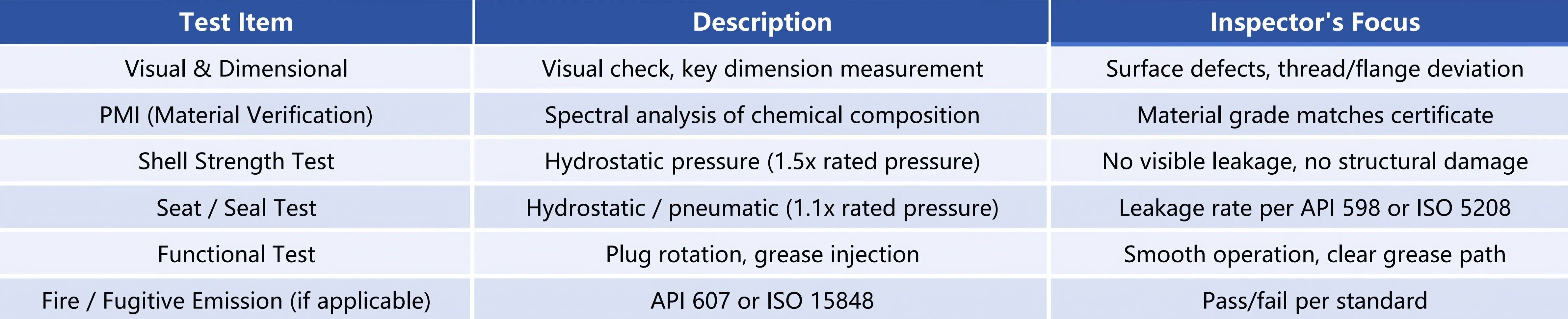
The inspector will witness the following tests (as specified in the ITP):
After testing
Stage 4: Inspection Report & Release
After inspection is completed
Typical time required
Process Flow
Submit ITP & documents → Agency review → Inspector on site → Document re-check → Visual & dimensional inspection → PMI → Pressure test → Functional test → (if applicable) Fire / fugitive emission test → Inspector confirmation → Report issuance → Release for shipment
If you have specific concerns about any stage or wish to adjust the witnessing method (e.g., remote video witnessing only), please let us know in advance. We will assist in coordinating with the inspection body.
If you have any other question or discuss more, please contact ZZJG PLUG VALVE.
Stage 1: Pre-Inspection Preparation
What we complete
- Prepare the Inspection and Test Plan (ITP) based on project specifications, clearly mark the key points (H) and the witnessing points (W).
- Compile material certificates, including EN 10204 Type 3.2 certificates (third-party endorsed) for body, plug and other critical components
- Prepare welding procedure qualification, welder qualifications, NDT personnel certificates, and calibration certificates for test equipment
- Complete internal pre-testing to ensure product readiness
What we need from you or the inspection body
- Confirmation of the ITP with written approval from BV/DNV/SGS
- Clarification on whether additional tests are required, such as fire test (API 607) or fugitive emission test (ISO 15848)
- Notification of inspector's arrival date and contact details
Stage 2: On-Site Arrival & Document Review
On the first day of inspection
- Verify completeness and validity of ITP, material certificates, test procedures, etc.
- Randomly select plug valves and check compliance with drawings and purchase specifications
- Verify that calibration certificates for test equipment are within validity period
Potential issues to note
- Material certificate not Type 3.2 → Replacement or supplementary documentation required
- Calibration certificate expired → Re-calibration required before testing can proceed
Stage 3: On-Site Witness Testing
The inspector will witness the following tests (as specified in the ITP):
After testing
- Inspectors signs original records if data is acceptable
- If non-conformities is found, the inspector records them, suspends witnessing until corrections are made and re-inspection is requested
Stage 4: Inspection Report & Release
After inspection is completed
- We prepare complete test reports and photo/video records
- BV/DNV/SGS issues the third-party inspection report or release note (signed and stamped)
- The inspection report is delivered to you together with the product
Typical time required
- Document preparation & pre-review: 5–10 working days
- On-site witnessing: 1–3 days (depending on quantity and test items)
- Report issuance: 3–7 working days
Process Flow
Submit ITP & documents → Agency review → Inspector on site → Document re-check → Visual & dimensional inspection → PMI → Pressure test → Functional test → (if applicable) Fire / fugitive emission test → Inspector confirmation → Report issuance → Release for shipment
If you have specific concerns about any stage or wish to adjust the witnessing method (e.g., remote video witnessing only), please let us know in advance. We will assist in coordinating with the inspection body.
If you have any other question or discuss more, please contact ZZJG PLUG VALVE.
Previous: Structural Differences and Application Selection of Lubricated and Non-Lubricated Plug Valves
Next: High-Performance 904L Plug Valves for Corrosive Service in Chemical Projects
Recent News
- High-Performance 904L Plug Valves for Corrosive Service in Chemical Projects
- Third-Party Inspection Process for Plug Valves
- Structural Differences and Application Selection of Lubricated and Non-Lubricated Plug Valves
- Plug Valve Selection for New Pipelines: 4 Core Questions to Answer Before Procurement
- Why Anti-Static Design in Plug Valves for LNG and Fuel Oil Pipeline Safety
- How To Grease a Plug Valve?